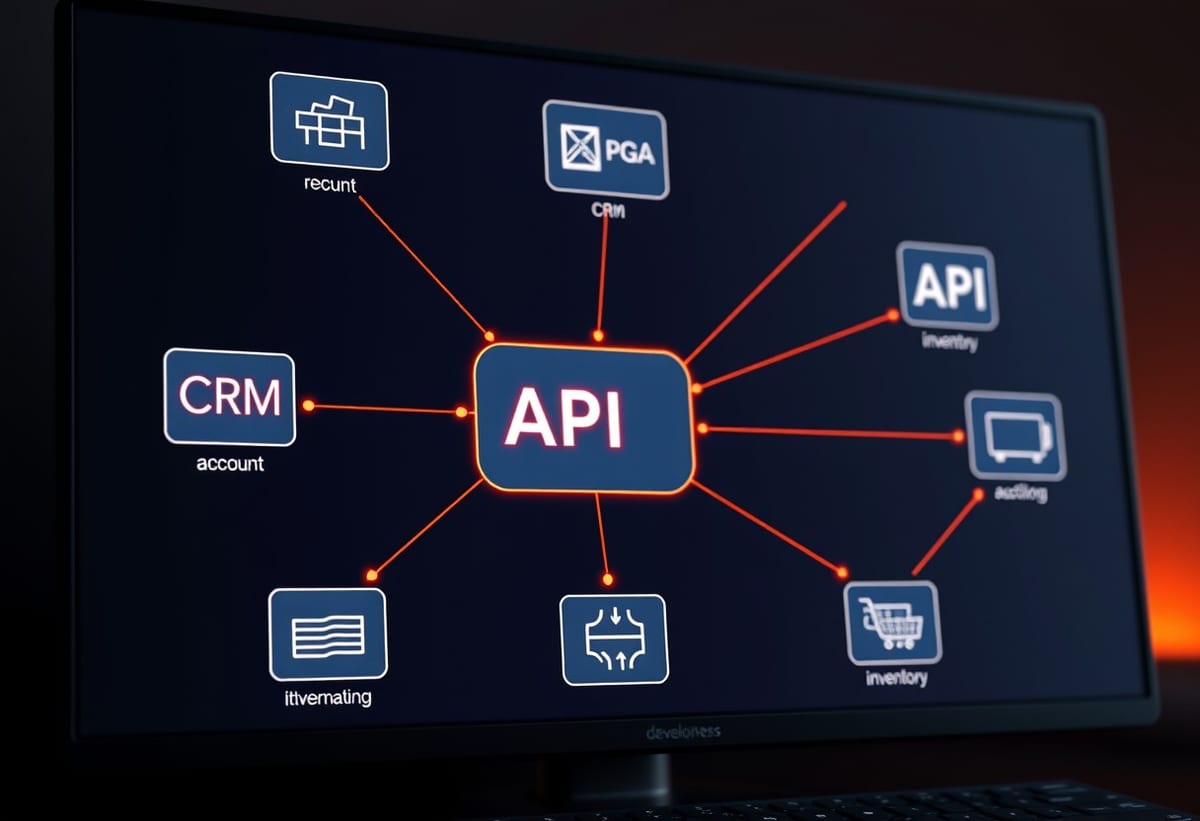
Custom API development is the process of building the software bridges that let your business systems talk to each other automatically. For UK SMEs running multiple software tools that do not natively integrate, custom APIs eliminate manual data entry, reduce errors, and enable real-time data flow between systems. Rather than replacing your existing software, APIs connect it, letting each tool do what it does best while the data flows cleanly between them.
What Is an API and Why Does Your Business Need One?
An API, or Application Programming Interface, is a set of rules that allows one piece of software to communicate with another. Think of it as a waiter in a restaurant. You do not go into the kitchen and cook the food yourself. You tell the waiter what you want, and the waiter communicates with the kitchen and brings back the result. An API does the same thing for software systems.
When your CRM needs to know what invoices have been sent, it asks the accounting system through an API. When your e-commerce platform needs to check stock levels, it asks the inventory system through an API. Without APIs, a person has to look up the information in one system and manually enter it into another.
How Do You Know Your Business Needs Custom API Development?
The signs are usually visible in the daily routines of your team.
Someone Is Copying Data Between Systems Every Day
If a member of your team spends part of every day exporting data from one system, formatting it, and importing it into another, you need an API. This manual process is not just inefficient. It is error-prone. A single typo in a customer record or an invoice amount can cascade through your systems. According to research by the British Chambers of Commerce, manual data entry errors cost UK businesses an average of £10,000 per year in rework and corrections.
Your Systems Cannot Talk to Each Other
You have a CRM, an accounting system, an inventory tool, and an e-commerce platform. They are all good at their individual jobs. But they do not communicate. A customer places an order on your website, but the inventory system does not know about it until someone manually updates it. The accounting system does not record the sale until someone manually enters it. This is the integration gap that custom APIs fill.
You Want to Automate Workflows But Cannot
If you have identified processes that should be automated but cannot because the systems involved do not have native integrations, custom API development is the answer. APIs make automation possible by providing the data connections that automation tools need. Our workflow automation services rely on well-built APIs to connect systems and automate processes end to end.
What Are the Types of API Integration?
Not all API integrations are the same. Here are the main types and when each is appropriate.
Point-to-Point Integration
The simplest approach. You build a direct connection between two systems. This is appropriate when you have a small number of systems and a limited set of data flows. It is fast to build and easy to understand but becomes complex to maintain as the number of systems grows.
Hub and Spoke Integration
You build a central integration layer that connects to all your systems. Each system talks to the hub, and the hub routes data between them. This is more maintainable than point-to-point when you have many systems, because adding a new system only requires connecting it to the hub rather than to every other system.
Event-Driven Integration
Systems communicate through events. When something happens in one system, it publishes an event, and other systems that are interested receive and react to it. This is the most flexible and scalable approach, ideal for real-time data flow and complex business logic.
API Gateway
A single entry point for all external systems and applications to access your APIs. The gateway handles authentication, rate limiting, and routing. This is appropriate when you need to expose your APIs to external partners, customers, or third-party applications. Our custom API development services cover all these integration patterns.
How Much Does Custom API Development Cost?
API development costs depend on complexity, the number of systems involved, and the volume of data being transferred. Here are typical ranges for UK SMEs.
Simple Point-to-Point Integration
Connecting two systems with a straightforward data flow, such as syncing customer records between a CRM and an accounting system. Typically £3,000 to £8,000.
Multi-System Integration
Connecting three or more systems with bidirectional data flow and some business logic. Typically £10,000 to £25,000.
Complex Integration Platform
Building a central integration layer with an API gateway, connecting five or more systems, with event-driven data flow and custom business logic. Typically £25,000 to £60,000.
The comparison that matters is against the cost of manual data entry. If a member of your team spends 10 hours per week copying data between systems, that is over 500 hours per year. At £25 per hour, that is £12,500 per year in wasted labour. An API that eliminates that manual work pays for itself quickly.
How Long Does API Development Take?
- Discovery and specification: 1 to 2 weeks
- API design and architecture: 1 to 2 weeks
- Development and testing: 3 to 8 weeks
- Integration and deployment: 1 to 2 weeks
Total elapsed time is typically 6 to 14 weeks. Simple integrations can be built faster, while complex multi-system platforms take longer. The key is to start with the most painful integration gap and build from there. Our guide on system integration for UK SMEs covers this incremental approach in detail.
What Are the Security Considerations for Custom APIs?
Security is critical when APIs handle business data. Here is what to consider.
Authentication and Authorisation
Every API request should be authenticated. The most common approach is API keys or OAuth tokens that identify the calling system and verify its permissions. Authorisation ensures that each system can only access the data it is entitled to.
Data Encryption
All data transmitted through APIs should be encrypted using HTTPS. Sensitive data, such as personal information subject to GDPR, should be encrypted at rest as well as in transit.
Rate Limiting and Monitoring
APIs should enforce rate limits to prevent abuse and ensure fair usage. Monitoring tracks API usage, identifies errors, and alerts you to issues before they affect your business. According to the UK government’s Cyber Security Breaches Survey, 32% of UK businesses identified a cyber breach or attack in the last year, making API security a priority rather than an afterthought.
Compliance
If your APIs handle personal data, they must comply with GDPR. This includes data minimisation, purpose limitation, and the right to erasure. APIs in regulated sectors like healthcare or financial services have additional compliance requirements. Our industry-specific solutions account for these requirements.
How Do You Choose Between Custom APIs and Integration Platforms?
Integration platforms like Zapier, Make, and Workato offer pre-built connectors between popular SaaS tools. They are a good starting point for simple integrations but have limitations for UK SMEs.
When Integration Platforms Are Sufficient
If you are connecting two popular SaaS tools (like HubSpot and Xero), the data flow is simple, and the volume is low, an integration platform may be all you need. They are quick to set up and require no development.
When Custom API Development Is Necessary
Integration platforms fall short when you need to connect to custom or legacy systems, when the data flow involves complex business logic, when the volume is high enough to make per-task pricing expensive, or when you need real-time data flow rather than batch processing. Custom APIs give you full control over the integration, no per-task fees, and the ability to handle any system, not just those on the platform’s connector list.
If you operate in a specific sector, we have guidance tailored to your needs. For example, e-commerce businesses connecting storefronts to back-office systems can benefit from our software for ecommerce insights.
Recommended Reading
- System Integration for UK SMEs - The broader context of connecting business systems beyond just APIs.
- Workflow Automation: Replacing Manual Processes with Software - How APIs enable end-to-end business process automation.
- Custom Software vs SaaS Total Cost of Ownership - The cost implications of integration choices.
Next Steps
If your team is spending time manually moving data between systems, custom API development can eliminate that work and give you real-time data flow. Explore our custom API development services to see what is possible, or book a free discovery call to discuss your specific integration needs. For businesses in sectors with specific system requirements, our industry-specific solutions show how APIs connect the tools your sector relies on.